What the two are
- A free address on a platform is a page inside someone else’s domain. It comes as a path (platform.com/yourname) or a subdomain (yourname.platform.com). Either way, the part that counts, platform.com, belongs to the platform.
- A custom domain is a name you register yourself: yourname.com. You rent it by the year from a registrar, it’s recorded as yours, and you decide which site and which email it points to.
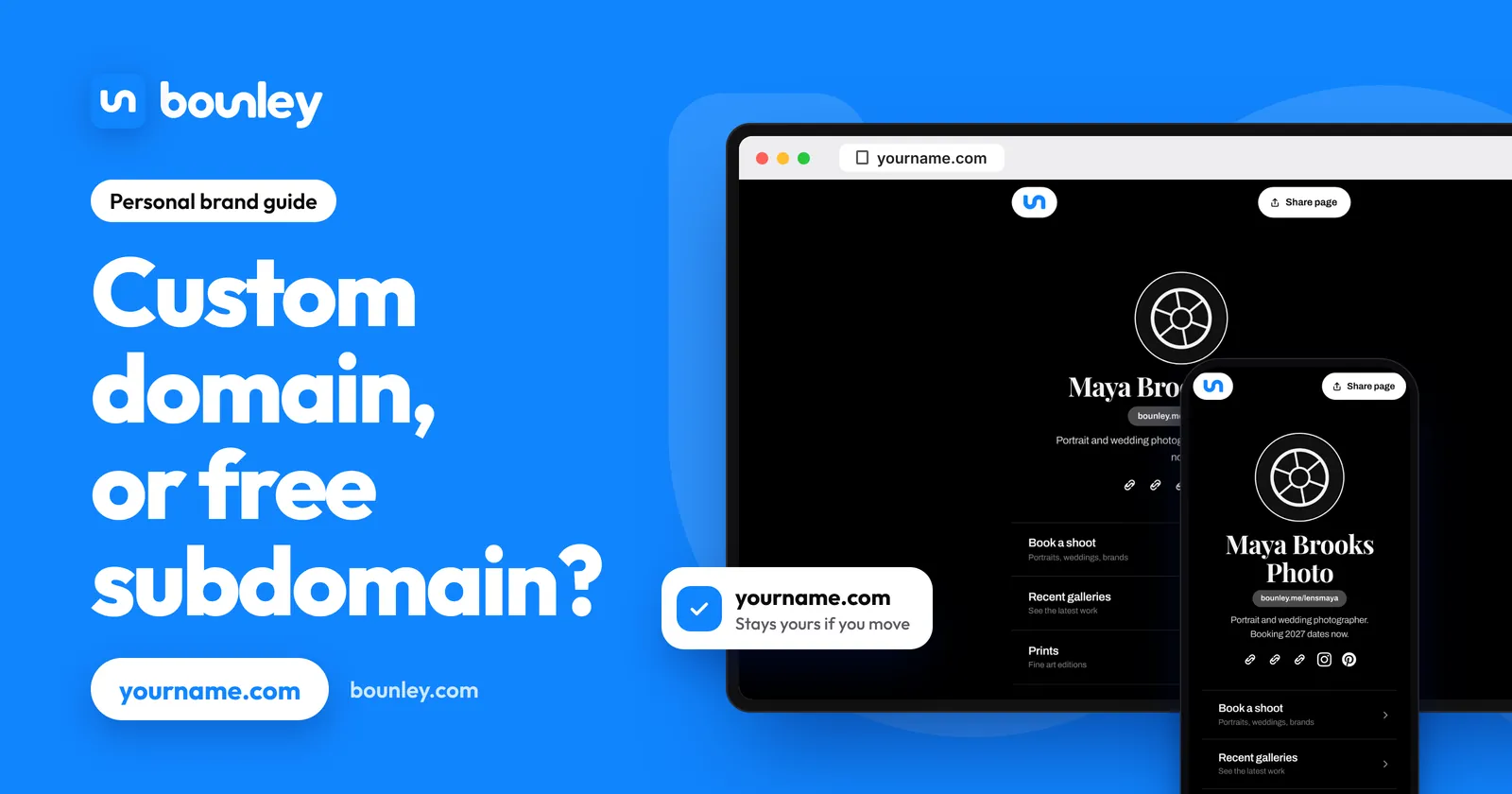
Bounley has both: every site starts at bounley.me/yourname, free, and with Premium the same site runs on your own domain. So this isn’t an argument against free addresses. It’s about knowing what each is good for.
Side by side
| Free address on a platform | Your own domain | |
|---|---|---|
| Cost | Free | Typically $10 to $20 a year for a .com |
| Whose name is in it | The platform’s, then yours | Yours only |
| If you change tools | The address stays behind; every link to it breaks or shows the old page | The address moves with you; nobody notices |
| Email at it | Not possible | you@yourname.com |
| Links you’ve earned | Point at the platform’s domain | Point at yours, and keep counting if you move |
| Printed on a card or merch | Advertises the platform | Advertises you |
| Setup | None | A few DNS records, or none if your platform puts them in |
Where the difference shows up
You can leave without losing anything
This is the one that matters most and is noticed last. Every bio, video description, business card, podcast mention and old email that carries your address keeps working for as long as that address does. On a platform’s address, that’s for as long as you stay with the platform. On your own domain, you can change the tool behind it in an afternoon and every link ever printed still lands on you.
Email comes with it
An email address needs a domain behind the @. A free page can’t give you one; a domain can give you as many as you want. For many people the email is the bigger reason to buy the domain: a Gmail address or your own domain compares the two.
It reads as established
yourname.com in a bio or a pitch looks like someone who intends to be around. It’s a small signal, but it’s one of the few a stranger sees before deciding whether to tap or reply.
Your name in search
Search engines treat a domain as a site of its own. A site at yourname.com, with your name in its address, title and heading, and your profiles linking to it, is a clear candidate for searches of your name. A page on a shared domain can rank too; you just have less say in how.
When the free address is enough
- You’re trying something out and may change the name.
- It’s a personal page, not something you earn from.
- You need to be online today and will sort the domain out this month.
One thing to do now even so: check whether yourname.com is free, and if it is, consider holding it. Names get taken, and it costs little to keep (is buying your name as a domain worth it?).
How to switch without losing people
- Register the domain in your own name. At a registrar, or through a platform that registers it for you. How to get yourname.com.
- Connect it to your site. Add the records your platform asks for, or let it add them. How to connect a domain to a website.
- Keep the old address working. Most platforms keep the free address live or forward it. Leave it in place so old links still arrive.
- Update the places you control. Bios first, then your email signature, card and pinned posts.
- Turn on email at the domain. Once the site is there, add the address people will write to.
With Bounley Premium the switch is one step: your site moves from bounley.me/yourname to yourname.com, the old address keeps working, and email at the domain is set up at the same time. Premium is invitation-only during the beta: join the waitlist and we’ll email you the day it opens.
Questions
What’s the difference between a domain and a subdomain?
A domain is a name you register, like yourname.com. A subdomain is a name in front of someone’s domain, like yourname.platform.com; it belongs to whoever owns the domain after it.
Is a custom domain worth it for a personal website?
If you earn under your name, or plan to, yes: it’s the only address that stays yours when you change tools, and the only way to have email at your name.
What about a subdomain of my own domain?
That’s different, and useful: blog.yourname.com or shop.yourname.com are yours, because the domain behind them is. The comparison here is with subdomains of a platform’s domain.
Does it have to be a .com?
No. .com is what people type by default, so take it if it’s free. .co, .me or an ending for your work are fine when it isn’t.