Side by side
| yourname@gmail.com | you@yourname.com | |
|---|---|---|
| Cost | Free | A domain (typically $10 to $20 a year for a .com) plus an email service |
| What it says | A person’s private address | Someone who works under their own name |
| The name you get | Whatever is left: often with numbers or extra letters | Any address you want: your first name, contact@, bookings@ |
| If you change provider | You can’t take the address with you | The address stays; only where it’s hosted changes |
| More than one address | One, plus aliases with a + | As many as you like at your domain |
| Newsletters and email tools | Sending tools generally can’t send as a free address any more | Yes, once the domain’s records are set up |
| Matches your website | No | Yes: one name on the site, the email and the signature |
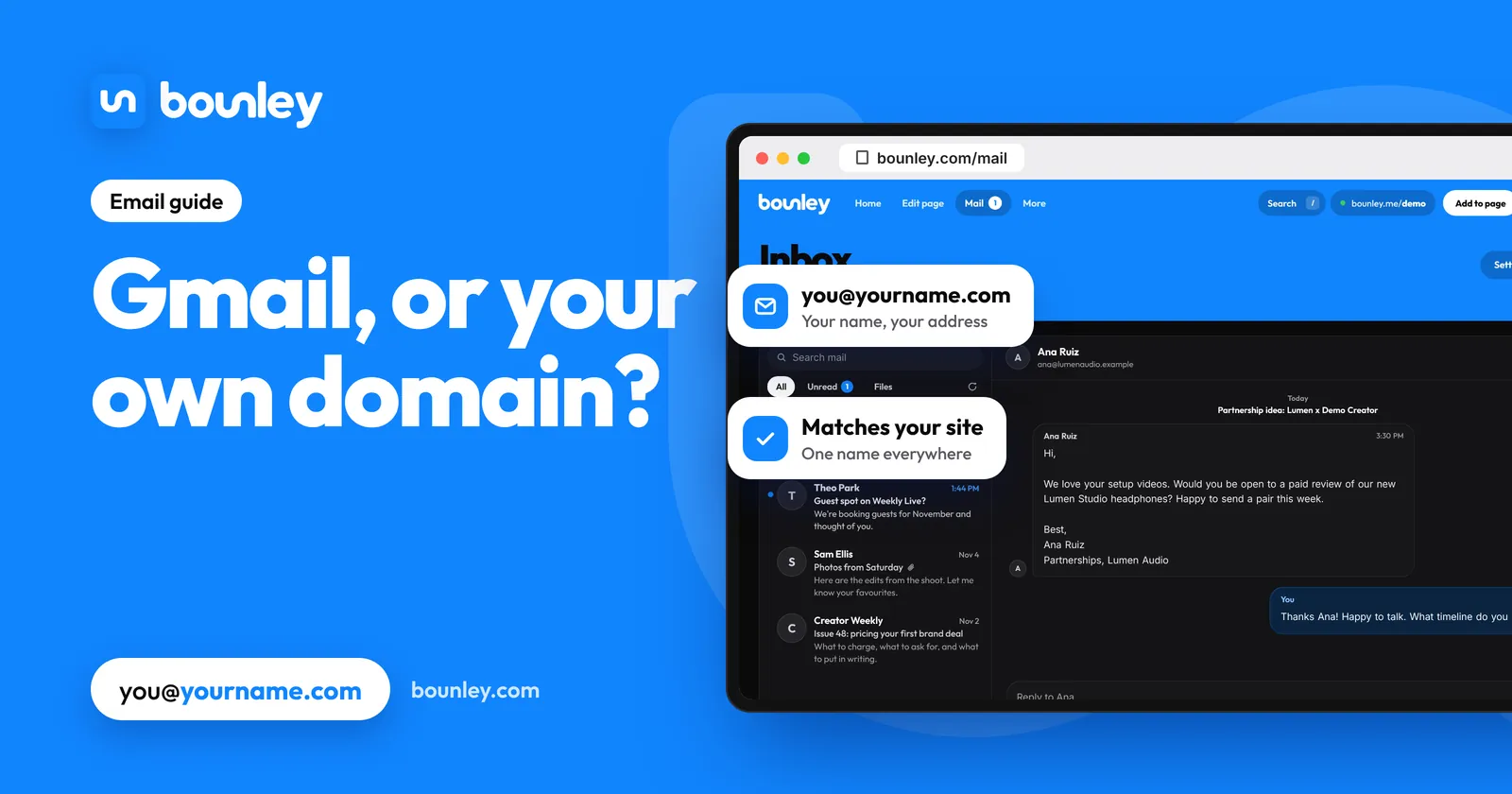
How each one reads to the person receiving it
Nobody rejects an email because it came from Gmail. What changes is the first impression in a crowded inbox. A brand’s partnerships manager or a client’s accounts team sees hundreds of messages; the sender’s address is one of the few things visible before they open one.
- jess@jessmoreno.com reads as a business. It matches the website in the signature, and it’s obviously the right person.
- jessmoreno.creates@gmail.com reads as an individual, which is fine if that’s all you need to be.
- jessm_2003@gmail.com reads as a personal account from years ago. This is the one worth replacing first.
If you stay on a free address, make it the cleanest one you can get: your name, no numbers, no nicknames. Professional email address ideas has formats that work.
Deliverability: what actually changes
For one-to-one email, both reach inboxes: a message typed in Gmail and sent from a gmail.com address is trusted. Two things are different with your own domain:
- You have to set it up properly. A domain needs MX records to receive mail and SPF, DKIM and DMARC records so receiving servers can check that mail really comes from you. Without them, mail from a new domain is more likely to land in spam. Why emails go to spam explains each record.
- You can send through other tools. Since 2024, Google and Yahoo have required bulk senders to authenticate their own domain, and newsletter and email marketing tools generally won’t send as a free gmail.com or yahoo.com address. If you ever want a newsletter in your name, you need a domain.
Can you keep using Gmail with your own domain?
Yes, with Google Workspace, Google’s paid plan, which gives you Gmail’s inbox at your own domain. The older free routes, reading another account’s mail in Gmail and sending as it, are being withdrawn: Google’s help pages say “Send mail as”, POP fetching and Gmailify end for addresses Google doesn’t host in January 2027, and new users already can’t set up the last two. The details and the alternatives are in can you use Gmail with your own domain?
When a Gmail address is fine
- It’s your personal email, for friends, family and accounts.
- You’re just starting and haven’t settled on the name you’ll work under.
- Nobody is paying you yet, and nobody is searching for you.
Keep it for those things even after you get your own domain. Most people end up with both: a private address, and a public one at their name.
When to switch
- You’re emailing brands, clients, agents, venues or employers.
- You have a website, or are about to: the email should match it.
- You want separate addresses for bookings, press or support that all reach you.
- You want a newsletter that comes from you.
- Your current address has numbers or a nickname in it.
How to get you@yourname.com
- Get the domain. Check yourname.com with the domain name ideas tool, which also shows the email addresses that would go with it.
- Choose where the inbox lives. A paid mailbox from an email host, or a service that includes it. How to get a professional email address compares the options and their costs.
- Add the records. MX, SPF, DKIM and DMARC, at the company that runs your domain’s DNS.
- Tell people. Put the new address in your bios, signature and media kit, and forward your old one for a few months.
Bounley Premium does the first three together: your domain, an email address at it starting as contact@yourname.com, the inbox inside Bounley next to your site, and every record put in for you on a domain from Bounley. It’s invitation-only during the beta: join the waitlist and we’ll email you the day it opens.
Decided to move? How to switch to an email address at your own domain gives the order to do it in, so no mail is lost.
Questions
Is it unprofessional to use a Gmail address for business?
Not unprofessional, but it tells the reader less. An address at your own domain shows that you work under that name and matches your website; a clean Gmail address (your name, no numbers) is the next best thing.
How much does email at your own domain cost?
The domain is typically $10 to $20 a year for a .com. The mailbox is priced per address each month by most email hosts; check each provider’s current prices. Some services include it with a site and domain.
Will I lose my old emails if I switch?
No. Your Gmail account stays as it is. You start sending from the new address and forward the old one to it while people update their contacts.
Can I have both?
Yes, and most people do: a private Gmail address for personal life and an address at your own domain for work.