Why it matters for academics
Hiring committees, journalists, prospective students and collaborators all begin with a search. A department page, a Google Scholar profile and an old conference bio give them three partial answers. A site of your own gives one, says what your work is about in a sentence a non-specialist can follow, and doesn’t vanish between a PhD, a postdoc and a lectureship.
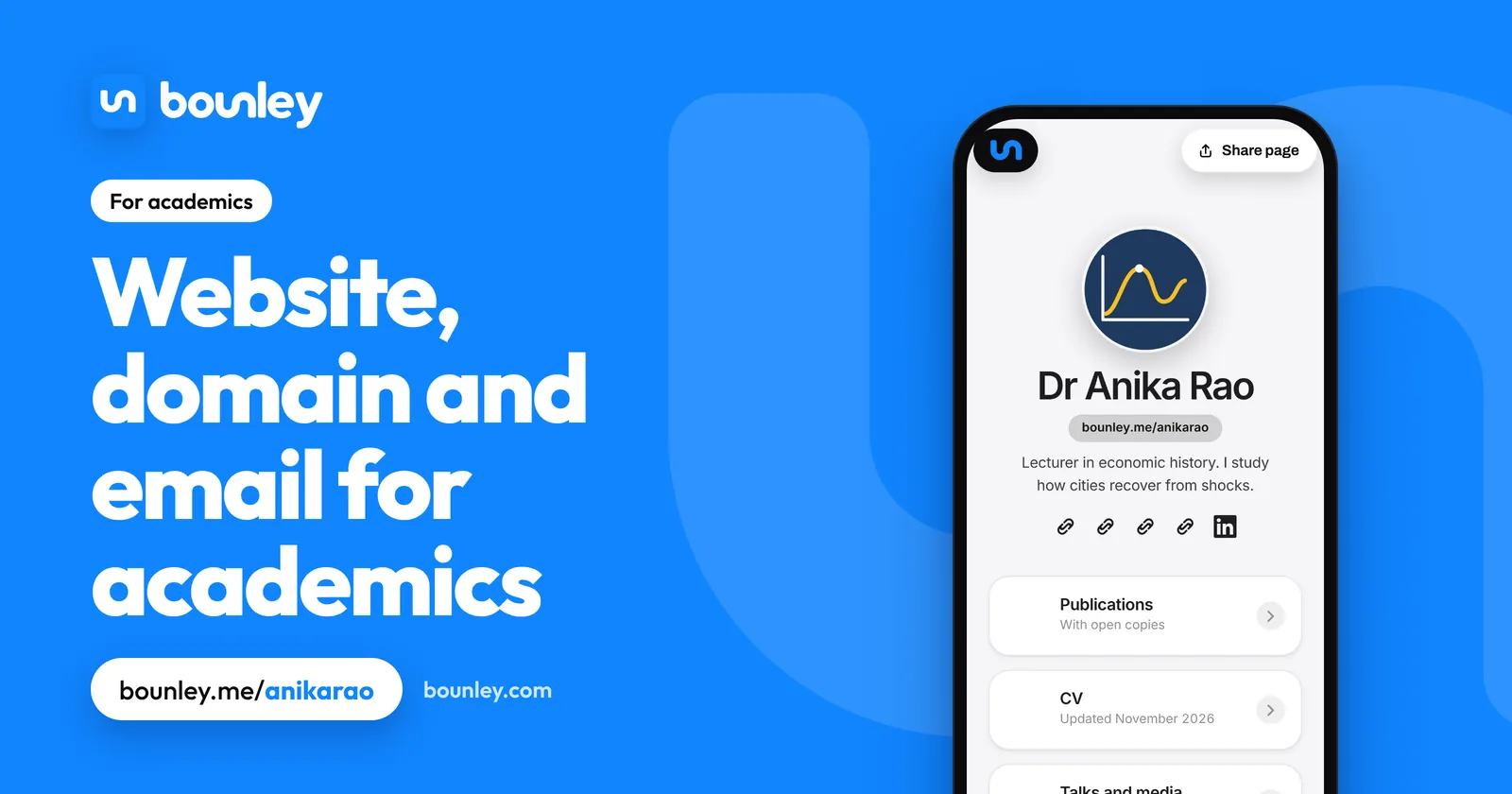
What an academic’s site needs
- Your name, position and institution, and your field in one plain sentence.
- Research: two or three themes, each in a short paragraph.
- Selected publications, with links to open-access copies or preprints where you have the right to share them.
- Your CV as a PDF, dated.
- Teaching: courses, and materials you’re happy to share.
- Talks, media and public writing.
- For prospective students: whether you’re taking any, and how to approach you.
- Links to ORCID, Google Scholar and your institutional page.
Bio examples for academics
- “Lecturer in economic history. I study how cities recover from shocks.”
- “Postdoc in computational biology. On the job market for 2027.”
- “Professor of linguistics. Endangered languages of the Pacific.”
Sharing papers, and saying things in public
Check each publisher’s policy before posting a paper: most allow a preprint or the accepted manuscript on a personal site, fewer the final typeset version. Link the version of record as well. Write a two-line plain summary under each paper; it’s what journalists and people outside your field read, and what AI assistants quote. If you comment publicly, a line that views are your own keeps the site clearly personal, and your institution’s policy on external communications still applies.
Your domain and email
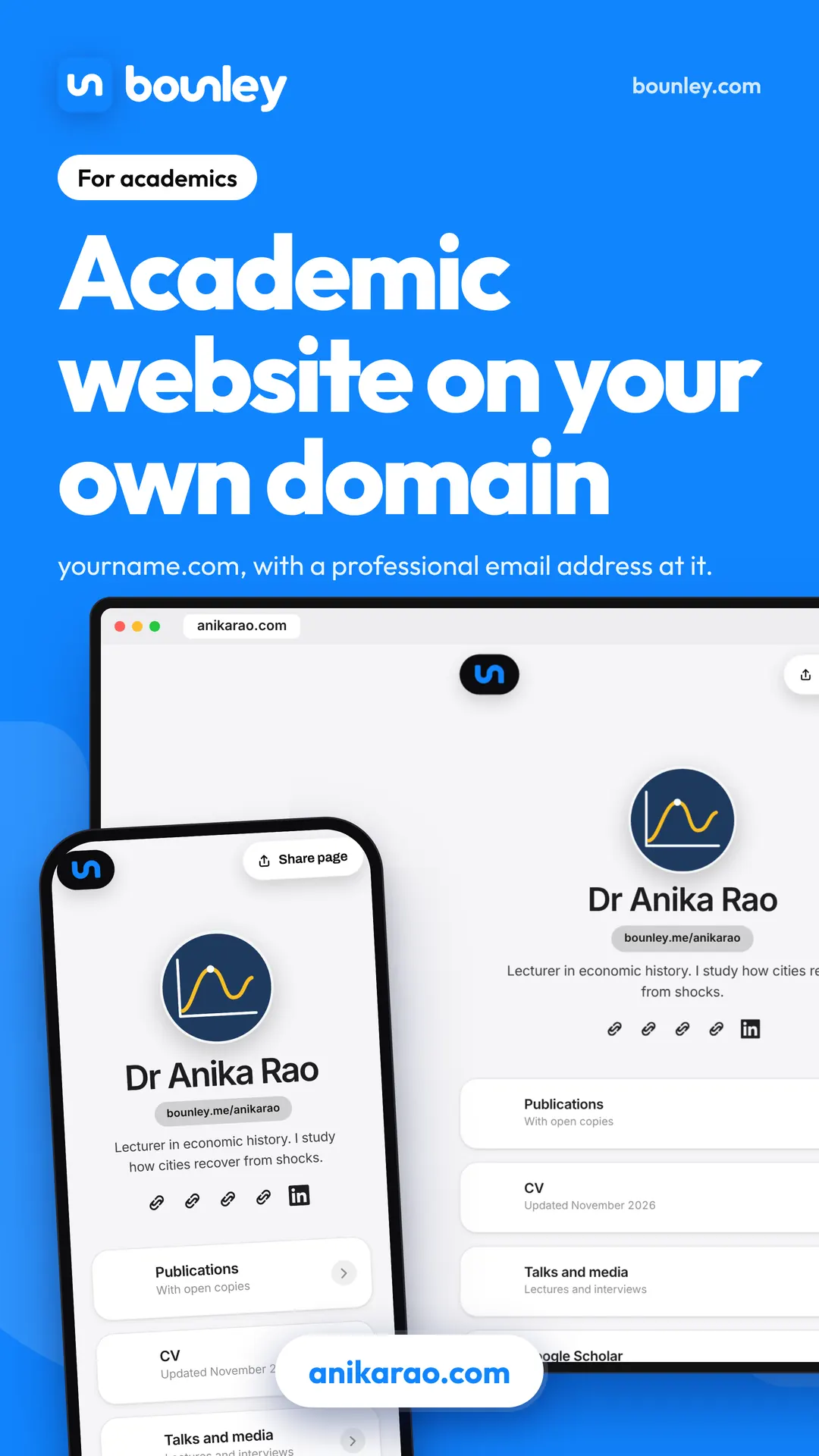
A university address ends with the post, and with it a decade of correspondence and every journal account registered to it. you@yourname.com is the address to put on papers and profiles so collaborators can still reach you three institutions later. Your name as published is the domain. A personal email domain.
What to put first
- Your name, position and one sentence on your research.
- Selected publications.
- CV.
- Teaching and talks.
- Contact, and a note for prospective students.
What loses the reader
- A research statement only three people can understand.
- A publication list with no links.
- A CV dated four years ago.
- A page hosted on a previous university’s server, slowly breaking.
How Bounley fits
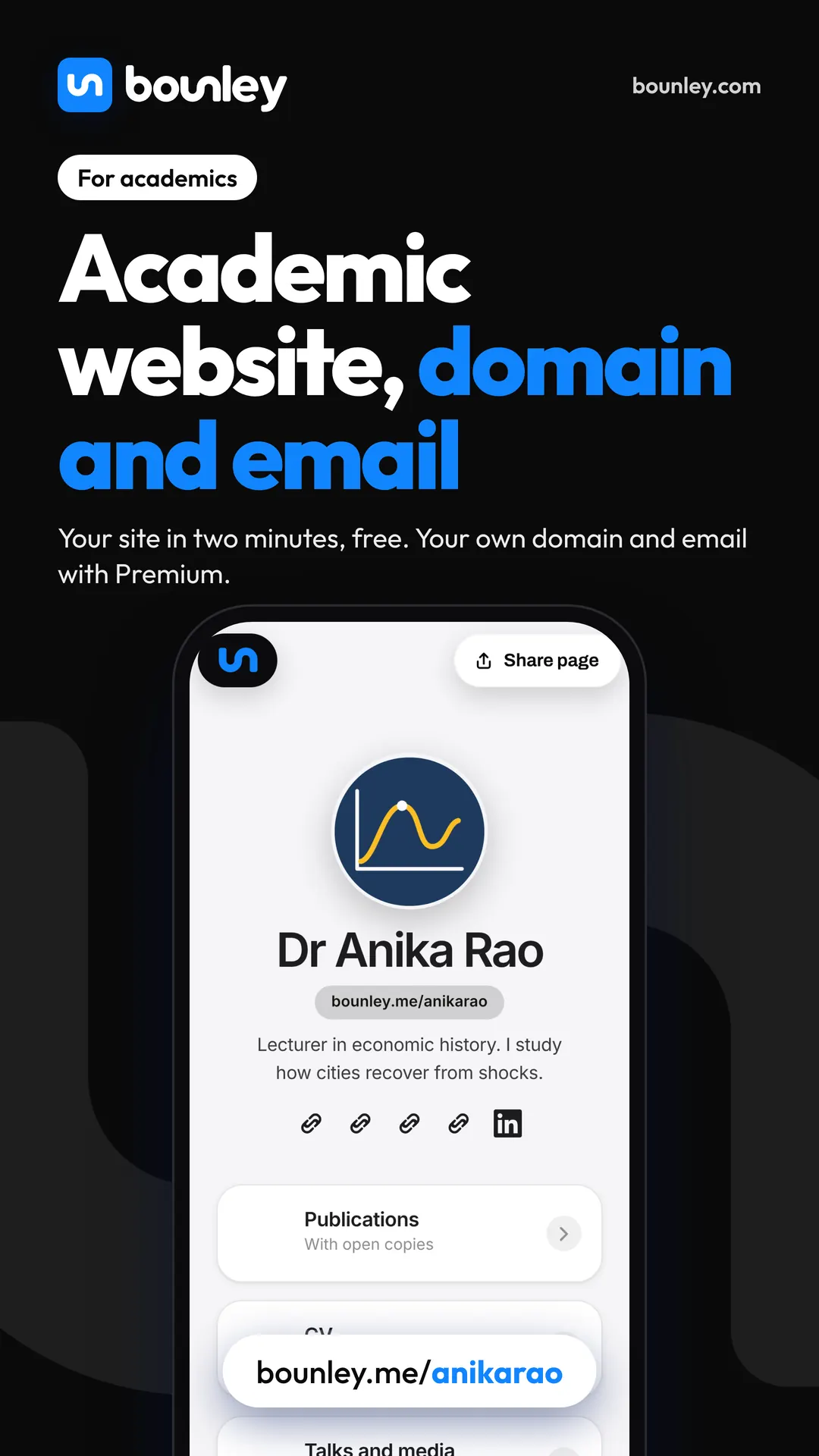
Bounley builds a clean personal page from your details in about two minutes, with buttons for your papers, CV, Scholar and ORCID, talks that play on the page, and a contact form. With Premium it runs on your own domain, with your email and a blog at blog.yourname.com for writing about your research in plain language.
Questions
I have a university profile. Why a personal site?
The profile belongs to the university and ends with your contract. A personal site moves with you and lets you present your work your way. Link each to the other.
Should PhD students have one?
Yes, especially before the job market. A simple page with your research, a CV and a paper or two is what search committees look for.
Can I post my papers on my site?
Usually a preprint or accepted manuscript, depending on the publisher’s policy. Check each one and link the published version.
Should I stop using my university email?
Use it for university business. For papers, profiles and anything that should reach you in ten years, use an address you’ll keep.
Related: a personal brand for students and for authors, and how to show up when someone searches your name.