Why people want all three together
Because they’re one thing to the person on the other side. The address in your bio, the address they email and the name in your signature should be the same name. When the three come from different companies, you’re the one who connects them: copying records between dashboards, paying three renewals, and finding out which company to ask when mail stops arriving.
The four kinds of all-in-one
| Kind | What you get | Suits | Check |
|---|---|---|---|
| Domain registrar with a builder | The domain, a simple site maker, and often one mailbox or forwarding | A basic page and one address, cheaply | Whether “email” is an inbox or just forwarding; how limited the site is |
| Web hosting bundle | Hosting, a free domain for the first year, mailboxes, and a site builder or WordPress | People happy to manage hosting | Renewal prices after year one; how much you have to maintain |
| Website builder with add-ons | A strong site builder, a domain on paid plans, and email sold as an extra from a partner | Larger sites and shops | Email is usually a second subscription, charged per address |
| Personal brand platform | A site made from your accounts, your own domain, and an inbox at it, set up together | One person: creators, freelancers, coaches, anyone whose name is the brand | Not meant for shops or many-page sites |
Offers change often, and what’s included differs by plan and country, so check each company’s own page before you buy. The named website builders are compared in the best website builders for personal brands.
What “included” usually means
- “Free domain” is normally free for the first year, then renews at the standard price. Look for the renewal price, not the first-year one.
- “Email included” can mean a full mailbox, a small one, a trial, or forwarding to your existing address. Forwarding lets you receive at your domain but not send from it properly.
- “Professional email” as an add-on is often a well-known office suite resold, billed per address each month on top of the site.
- “Connected” can mean set up for you, or a list of DNS records for you to add.
Seven questions before you choose
- Is the email a real inbox I can send from, at my own domain?
- What will I pay in the second year, for the domain, the site and the email?
- Who adds the MX, SPF, DKIM and DMARC records? (Why they matter.)
- Is the domain registered in my name, and can I move it?
- Does the site look right on a phone without extra work?
- How long does it take to change something?
- If I leave, what do I take with me?
When separate is better
Keeping the three apart is the right call if you want a specific email provider, need shared drives and calendars with your mail, already have a site you like, or want to be able to replace any one part without touching the others. Bounley or doing it yourself walks through that route step by step.
How Bounley does it
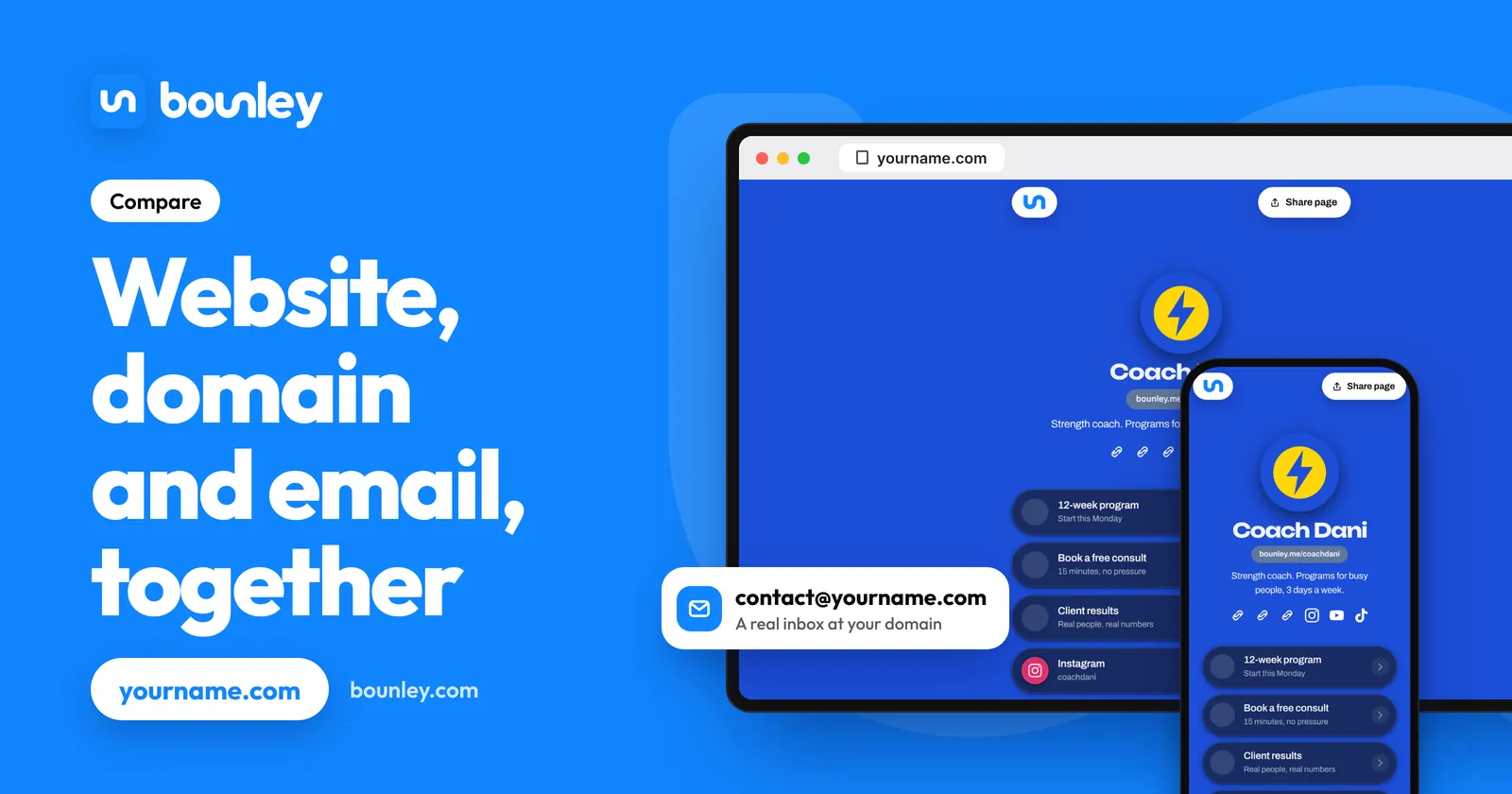
Bounley is the fourth kind: the platform built for personal brands. Your site is made from your accounts in about two minutes and is free at bounley.me/yourname while Bounley is in beta. With Premium:
- The domain: get one through Bounley, or connect one you own.
- The email: a real inbox, inside Bounley, starting as contact@yourname.com. Mail to any address at your domain arrives in it, and replies go out from the address written to.
- The records: on a domain from Bounley, every record the site and email need is put in for you, and checked before the domain sends.
- The rest: a business card, QR code and email signature made from the site, and a blog at blog.yourname.com.
Bounley Premium lists everything. It’s invitation-only during the beta and its price hasn’t been announced: join the waitlist and we’ll email you the day it opens.
If the three words still blur together, start with domain, hosting and email, explained, and see what each piece typically costs.
Questions
Can I get a website, domain and email from one company?
Yes. Registrars, hosting companies, some website builders and personal brand platforms all sell the three together. They differ in what the email really is, what it costs after the first year, and how much setting up is left to you.
Does a domain come with free email?
Sometimes: some registrars include one small mailbox or forwarding. A domain on its own gives you the right to have email at it, not an inbox.
What’s the cheapest way to get all three?
A registrar’s own bundle or a hosting bundle is usually cheapest in the first year. Compare second-year prices and how much upkeep each needs before deciding on price alone.
Can I move later if I start with a bundle?
If the domain is registered in your name, yes: you point the site and the email at new providers and the address doesn’t change. That’s the reason to check who the registrant is.